My first post in this category: #Existential Perspectives


Exploring #ExistentialPerspectives: A Journey into Shared Human Experience

This site is dedicated to reflecting on the #ExistentialPerspectives that all human beings encounter at various moments in their everyday conscious experience. It delves into the profound sense of being unique, yet confined to one’s individual physical existence—seeing, sensing, and acting from a deeply personal perspective. Often, this awareness evokes feelings of being all alone or imprisoned within one’s body, alongside the paradoxical realization that such experiences are universal, shared by others in their own moments of introspection.

At its core, this is a deeply human journey—a search for connection, meaning, and understanding in relation to the world around us. It reflects our collective struggle to reconcile individuality with the shared essence of existence.

Through this blog, I share personal reflections, thoughts, and ruminations on my own existential experiences, which I believe mirror those of others. These posts also draw from my interests in philosophy, clinical psychology, and related disciplines, along with readings in popular science—exploring how they intersect with and illuminate our human existence.


🌞 Midday Reflections on the Universe and Life

“In midday, I would sit down at the picnic table and immerse myself in the latest article on cosmology in Scientific American, pondering the bursts of innumerable bubbles of matter within the space balloon—a cosmic tapestry beyond the singular Big Bang. These bubbles, scattered across the balloon’s surface, trace the origins of our expanding Universe some 15 billion years ago.

How fascinating that this expansion accelerates due to the mysterious forces of Dark Energy and Dark Matter, which together constitute about 96% of everything we know—or rather, don’t know—about the Universe.

I’d marvel at how the Big Bang set in motion the formation of stars, galaxies, and black holes, including our own Milky Way, where Earth orbits the Sun and planets dance around their stars. Even our Sun revolves around the galactic center—harboring a massive black hole formed from the remnants of ancient stars long gone.

From galaxies merging and colliding in the cosmic dance, I see parallels with life on Earth: the big devouring the small, the strong dominating the weak—a rule that seems to transcend human history as well as the behavior of all living beings, reflecting patterns mirrored in the cosmic realm.

As I breathe in and out, I become aware of the rhythm of life—this inhaling and exhaling, expanding and contracting, mirrors the Sun’s expansion and contraction as it converts energy (from hydrogen to helium) to sustain all life. The Sun’s cycle of hydrogen fusion echoes the Universe’s own eternal rhythm of expansion and contraction, of creation and return, related to the possible Big Bang and Big Crunch—a stage in the Eternal Cycle of the Universe.

Then I’d pause to reflect on the trees, the rivers, the sky, and the Sun—on our interconnected existence. This awareness of breathing, an affirmation of my conscious living existence, gives me a sense of connection to everything within me and everything I perceive beyond myself.

It’s in this awareness that I sense the presence of an Ever-Present, Mysterious Creative Force—a force billions recognize by many names, yet which remains the same underlying essence in all things: living and non-living, visible and invisible, within us and beyond us.”


©️ Copyright Notice
This blog series by Mohiuddin Ahmed, originally published on https://existentialperspectives.wordpress.com in 2014, is protected by copyright. Unauthorized use or duplication of this material without express written permission from the author is prohibited. Excerpts and links may be used with full credit to Mohiuddin Ahmed and #ExistentialPerspectives, including appropriate references to the original content.


#ExistentialPerspectives #ExistentialReflections #HumanCondition #SpiritualScience #MindBodySoul #LifeAndMeaning #ExistentialInsights #TimelessTruths #CosmicReflections #InnerJourney #PhilosophyAndBeing #FromGriefToGrace #ExistentialWisdom #CosmologyAndMeaning #UniversalConnection

.

Human Advancement and the Limits of Enhancement

Reflections on Human Activities, Technological Progress, Overuse, and Adaptation

Mohiuddin Ahmed, Ph.D. Retired Clinical Psychologist

Introduction to the Series

In this series, I will share reflections drawn from more than nine decades of life, bringing together knowledge from various sources, personal observations, and my professional understanding of human behavior.

Throughout human history, we have expanded our knowledge and developed activities and technologies to improve our physical and mental functioning, overcome limitations, and enhance our quality of life. This ongoing process of advancement and adaptation has shaped who we are and how we live in an ever-evolving world.

Although these advancements have brought remarkable benefits, they can also have unintended consequences, particularly when used excessively or inappropriately.

My reflections will explore these benefits and risks across a range of human activities, with particular attention to emerging technologies such as artificial intelligence and medical advances that have extended and enhanced our mind–body capacities.

I intend to examine how these benefits and risks interact with individual differences, changing circumstances, and our capacity for adaptation. I will also consider how excessive use, misuse, or inadequate safeguards may lead to harm.

Insatiable Want, Human Imagination, and the Limits of Self-Regulation

The human desire for “more and more” is not new. Throughout history, our needs, desires, curiosity, and imagination have contributed to remarkable advances in civilization. Yet the pursuit of satisfaction can become an endless cycle in which fulfilling one desire gives rise to another.

I am reminded of the Buddha’s concept of dukkha, commonly translated as suffering or dissatisfaction, and his recognition of craving, or taṇhā, as an important source of human suffering.

Although these teachings arose in a different philosophical and cultural context, the questions they raise remain relevant to contemporary human behavior.

The modern consumer economy offers one example. Advertising, commercial competition, and the pursuit of profit can encourage the continual development and promotion of products and services while stimulating new consumer desires. Communication technologies, now including artificial intelligence, have expanded the capacity to reach consumers, influence their interests and choices, and encourage ongoing engagement and consumption.

Desire itself is not the problem. Our capacity to aspire beyond basic survival and sustenance is an important aspect of being human. While some of our needs are rooted in biological and evolutionary processes that support adaptation and survival in different environments, many of our wants reflect what psychologists describe as secondary, or learned, motives and preferences shaped by individual experiences, cultural learning, and exposure to different social environments. Without curiosity, aspiration, imagination, and the pursuit of improvement, many achievements of human civilization would not have been possible.

The concern arises when the pursuit of satisfaction becomes difficult to regulate and begins to interfere with other important aspects of life.

My clinical work in psychology has also led me to reflect on the relationship between behavior and its consequences. Activities that bring pleasure, satisfaction, or relief may be repeated even when their longer-term effects are less beneficial or potentially harmful.

In some circumstances, these patterns may become difficult to control and resemble compulsive or addiction-like behavior. Excessive engagement alone, however, does not establish a psychological disorder. The activity, individual circumstances, degree of control, and effects on everyday functioning must also be considered.

A related consideration is our remarkable capacity to create an internal world of thoughts, memories, fantasies, and mental imagery.

When these mental activities remain flexible, responsive to external reality, and open to evaluation, they can support creativity, scientific discovery, problem-solving, and personal development.

However, mental activities can also become repetitive, intrusive, and increasingly disconnected from immediate circumstances. Some individuals may become so absorbed in their internal experiences that they struggle to redirect attention toward everyday responsibilities and social interactions.

In certain psychiatric conditions, including psychosis, disturbances of thought and perception may involve more profound difficulties in distinguishing internally generated experiences from external reality. These conditions are complex and should not be reduced to excessive imagination or a failure of self-control.

The contrast between productive imagination and potentially disabling mental preoccupation nevertheless invites reflection on how we experience, evaluate, and regulate our internal mental activities.

Artificial intelligence adds another dimension to these concerns.

A person whose thoughts continually generate questions, imagined possibilities, anxieties, or desires can now turn to a technological system capable of providing a seemingly endless stream of responses.

What might once have remained within the individual’s internal world can become an extended exchange with a responsive artificial system.

In some circumstances, this interaction may support learning, creativity, and constructive problem-solving. In others, it may sustain repetitive questioning, excessive reassurance-seeking, or preoccupation with ideas that need more critical evaluation.

The question is not whether we should suppress curiosity, desire, or imagination.

Rather, it is how we can preserve their benefits while recognizing when they become difficult to regulate or interfere with our ability to live meaningful and productive lives.

The Black Hole of the Mind

These concerns connect with a broader psychological pattern that I describe metaphorically as the Black Hole of the Mind.

We can become so absorbed in thoughts, memories, fantasies, anxieties, resentments, or imagined possibilities that our attention drifts away from immediate surroundings and practical responsibilities.

One thought gives rise to another.

Revisiting the same concerns may bring temporary reassurance without lasting resolution.

New possibilities and uncertainties emerge, drawing us into further mental preoccupation.

These patterns can arise in a range of psychological circumstances and are not, by themselves, evidence of severe mental illness.

From a behavioral perspective, the temporary satisfaction or relief gained from continued mental engagement may reinforce the very process that sustains the preoccupation.

The individual may become increasingly absorbed in thoughts or activities that provide immediate psychological rewards while interfering with other meaningful aspects of life.

Artificial intelligence may sustain this process by offering a continuously available source of responses.

A system that repeatedly validates an individual’s fears, beliefs, or interpretations may unintentionally reinforce ideas that need more critical examination.

Similarly, a system that continually suggests new questions may encourage further searching when the individual would benefit more from accepting reasonable uncertainty and returning to meaningful activities.

The interplay of human curiosity, psychological reinforcement, and technological responsiveness may therefore make continued engagement increasingly difficult to regulate.

Extensive intellectual activity or prolonged use of technology should not automatically be considered harmful or addictive. Its effects depend on individual characteristics, circumstances, and whether the activity remains purposeful and under reasonable personal control.

The challenge is to ensure that technologies designed to extend human thinking do not encourage patterns that diminish independent judgment, control of attention, or meaningful participation in everyday life.

Technological Advancement, Human Responsibility, and Societal Safeguards

My concerns about technological advancement also extend beyond individual use, excessive engagement, and psychological dependence.

Human history shows that technologies born of extraordinary intellectual achievement can also be used for destructive purposes.

The development of nuclear weapons offers a sobering example of how scientific advancement can create risks far beyond the individuals or institutions controlling the technology.

Artificial intelligence presents different opportunities and risks, yet its rapid development raises related questions about human responsibility and the consequences of increasingly powerful technologies.

These concerns include not only excessive use or harmful dependence among individual users but also deliberate misuse by individuals, organized groups, or institutions pursuing destructive objectives.

History also shows how charismatic leadership, grandiose ambitions, rigid group identities, and destructive ideologies can shape collective behavior, sometimes with devastating consequences.

As technological capabilities grow, their misuse may threaten not only those directly involved but also communities and, in some circumstances, humanity at large.

The growing capabilities of artificial intelligence therefore require attention both to their beneficial applications and to the risks of intentional misuse or unintentional harm.

This raises questions about how technology developers, researchers, governments, professional organizations, and the public should share responsibility for anticipating risks and developing appropriate safeguards.

At the same time, efforts to prevent misuse must respect individual freedom, privacy, independent judgment, and the legitimate benefits of scientific innovation.

Safeguards must themselves be carefully evaluated so that efforts to protect people do not introduce unnecessary restrictions, surveillance, or other unintended consequences.

The challenge is not simply to develop more powerful technologies, but to cultivate the individual and collective wisdom needed to use them responsibly.

Purpose and Direction of These Reflections

I do not intend to offer a comprehensive review of scientific research on these subjects.

Rather, I will share personal perspectives and reflections informed by available knowledge, professional experience, and observations gathered throughout my life.

My intention is not to discourage human advancement or portray the pursuit of knowledge, satisfaction, or improved functioning as inherently undesirable.

Instead, I hope to encourage reflection on the relationship between human capacities, the activities through which we express them, and the consequences that may arise when those activities become excessive, difficult to regulate, or potentially harmful.

Please stay tuned for future installments of this series, in which I plan to explore further the issues and concerns raised in these reflections. I welcome readers’ thoughts and perspectives as the series develops.


Aging, Human Capacity, and the Limits of Renewal

Personal Reflections on Entering the Tenth Decade of Life

Mohiuddin Ahmed, Ph.D. Retired Clinical Psychologist

Introduction to the Series

As I enter the tenth decade of life, I have been reflecting on various aspects of human aging, drawing upon my personal experiences, lifelong professional interests in psychology and human behavior, and continuing exploration of scientific, philosophical, and existential questions.

These reflections concern not only the biological processes of aging but also the changing nature of our physical and mental capacities, emotional needs, desires, relationships, personal autonomy, and awareness of our finite existence. They also examine how scientific knowledge, technological advances, cultural traditions, spiritual beliefs, and individual choices may influence our adaptation to aging.

I wish to emphasize that these reflections should not be construed as a blueprint or guide for achieving optimal adaptation to aging or longevity. They represent personal observations and thoughts developed through my own experiences and intellectual interests, recognizing that human beings live under enormously diverse biological, environmental, cultural, social, and economic circumstances.

Throughout the world, individuals and communities have developed their own ways of adapting to life’s challenges, often with limited formal education, technological resources, or access to modern medical services. Many draw upon practical experiences, traditional knowledge, cultural practices, social relationships, and their own understanding of life to achieve a reasonable degree of harmony with themselves and their environments.

Formal education and technological advances can certainly expand human capabilities and improve living conditions. However, neither literacy nor access to sophisticated technology should be regarded as an exclusive measure of human wisdom, adaptive capacity, or personal fulfillment. Individuals with little formal education may possess considerable practical knowledge, sound judgment, and an understanding of their surroundings that enables them to lead meaningful, active, and sometimes remarkably long lives.

Another important consideration is that longevity should not be evaluated solely in terms of the quantity of years lived, but also in terms of the quality of life experienced during those years.

Some animal species, such as certain tortoises, are known for their exceptional longevity. Yet their long lifespan does not necessarily provide an appropriate standard for evaluating human existence. Different species have different biological characteristics, patterns of behavior, and ways of interacting with their environments. Moreover, our knowledge of how other species experience and process their surroundings remains incomplete.

For human beings, the significance of longevity must therefore be considered alongside physical and mental functioning, emotional well-being, social relationships, opportunities for meaningful activities, personal satisfaction, and the ability to adapt to changing circumstances.

Even these considerations cannot be reduced to a single universal standard. The quality of life experienced by an individual depends upon personal capacities, expectations, values, and the conditions under which life is lived.

A longer life may offer additional opportunities for meaningful experiences, but the number of years lived does not, by itself, determine the fulfillment derived from living them.

Rather than presenting these thoughts as a single lengthy essay, I have decided to publish them as a series of interconnected reflections, one section at a time. Each installment will explore a particular aspect of aging while contributing to the broader discussion of human capacities, their limitations, and the possibilities for maintaining a meaningful and fulfilling existence.

These are continuing reflections rather than definitive conclusions or universally applicable recommendations. Individual experiences of aging differ considerably, and the ideas discussed here are intended to encourage further thought and exploration.

The individual sections will be published progressively as Parts I, II, III, and so forth. As this is an evolving intellectual exploration, previously published sections may occasionally be revised or expanded to incorporate additional reflections, relevant scientific knowledge, and further considerations.

Author’s Note

The ideas and reflections presented in this series are based primarily on the author’s personal experiences, observations, professional knowledge, and lifelong intellectual interests as he enters the tenth decade of life.

Many of these ideas have previously been expressed or explored in the author’s publications and collaborative works with other mental health professionals, including books, scholarly articles, blog posts, and other media. The author gratefully acknowledges the many thinkers, writers, scientists, and philosophers whose works have stimulated his curiosity and influenced his thinking throughout his life.

The author also acknowledges the numerous role models who have influenced him since childhood, including family elders, historical figures encountered through school and community experiences, teachers in colleges and universities, and supervisors and mentors during his university education and professional internships. Later, professional colleagues and numerous graduate and postgraduate students whom he supervised individually provided further opportunities for intellectual development. These mentoring and supervisory relationships frequently became collaborative, mutually beneficial learning experiences in which knowledge, observations, and perspectives were shared and exchanged.

Most importantly, the author acknowledges the profound influence of his lifelong partner, a professional educator whose religious and cultural background, and life experiences  differed from his own upbringing. Throughout their life together, they have engaged in innumerable discussions, debates, and disagreements, sometimes almost daily. Yet these differences have provided continuing opportunities to understand, accept, and respect each other’s perspectives. In calmer, reflective moments, his partner has often served as a “second-thought person,” encouraging reconsideration of ideas and judgments from another perspective. An important feature of their relationship has been their practice of not allowing disagreements to carry over beyond the day.

Following his retirement from clinical psychology practice, the author’s interests in reading and exploring diverse subjects expanded considerably during his seventies, eighties, and nineties. These intellectual pursuits, together with his continued engagement in various forms of physical exercise and mind-body practices, have contributed to the reflections presented here.

A final acknowledgment concerns the cumulative contributions of scientific, medical, and technological advances to the preservation and enhancement of human physical and mental capacities. Developments in medical care, information technology, digital communication, and, more recently, artificial intelligence based on large language models have provided additional opportunities for maintaining physical functioning, expanding knowledge, and supporting intellectual activities.

The author recognizes that the benefits of these advances may vary considerably among individuals, reflecting differences in genetic and biological endowments, personal circumstances, environmental conditions, and access to available resources.

In developing these reflections, the author has also made informed and responsible use of AI as an aid to exploring information, organizing ideas, and editorial review, while retaining full responsibility for the ideas, interpretations, and final published content.

Part I: Aging — A Continuing Process of Adaptation

Human aging is a universal biological process, but its manifestations vary enormously among individuals. Although chronological age provides a convenient measure of the passage of time, it does not adequately describe the functional capacities of an aging individual.

Genetic inheritance, metabolic characteristics, environmental conditions, lifestyle, personal experiences, emotional responses, and access to medical resources all influence how aging unfolds. Cultural and societal differences, dietary patterns, economic hardships or opportunities, levels of physical activity, and exposure to health risks further contribute to individual variations in the aging process.

Consequently, two individuals of identical chronological age may differ considerably in their physical endurance, cognitive functioning, emotional stability, and ability to manage everyday activities. Such differences occur not only across geographical regions, cultures, and societies but also among individuals living within the same communities and environments. There is no universally applicable formula for successful aging.

Aging inevitably introduces changes in bodily functions, physiological efficiency, and the capacity for recovery. Nevertheless, the progressive appearance of limitations does not necessarily require withdrawal from meaningful activities. Rather, the challenge lies in recognizing changing capacities and learning to adapt behavior, expectations, and environmental conditions accordingly.

As people grow older, they may also become increasingly aware of the finite nature of human life and the gradual deterioration of the biological systems that sustain conscious existence. This process may be understood, in a philosophical rather than strictly thermodynamic sense, as part of the broader reality of entropy and the limits of biological renewal.

Such awareness may encourage greater engagement with spiritual or religious beliefs and practices, including a return to traditions learned earlier in life. Others may find meaning through philosophical reflection, contemplation of the natural universe, or different ways of understanding their relationship with the larger reality of existence.

With advancing age, changes in physical and mental performance become increasingly apparent, although their nature and severity vary considerably among individuals.

The objective, therefore, is not necessarily to maintain the physical and mental performance of earlier decades, but to make the best possible use of the capabilities that remain available.

This distinction between preserving functional capacity and attempting to reverse the natural course of aging provides a useful foundation for understanding aging, adaptation, and well-being.


This is Part I of an ongoing series of reflections on aging, human capacity, and the limits of renewal. Subsequent installments will explore additional biological, psychological, social, technological, and existential dimensions of aging.

#AgingAndHumanCapacity #HealthyAging #Psychology #Gerontology #ExistentialPhilosophy

Excellence of Mind and Body: Finding Fulfillment Without Comparison

The ancient Spartan ideal, personal aspirations, and the wisdom of living in harmony with ourselves and the world.

I was sharing a message with one of my nephews about his only child, who is writing his dissertation in a highly competitive scientific field at one of the world’s elite universities and has also completed a Half Ironman triathlon. His example reminded me of the ancient Spartan ideal of excellence in mind and body. This prompted a broader reflection on what it means to live a fulfilling life.

What matters most is not how far we surpass others, but how sincerely we pursue our own aspirations, make the best use of our abilities, and develop a sense of contentment with what we accomplish. Equally rewarding is watching others strive toward their own goals and finding joy in their achievements. Their successes can inspire us without becoming standards against which we must measure our own lives.

Each of us has a different combination of abilities, interests, opportunities, and limitations. Consequently, our paths to fulfillment cannot be identical. One person may excel in physical fitness, another in intellectual pursuits, another in artistic creativity, and yet another in caring for family, serving the community, or quietly enriching the lives of those around them. These contributions may differ in visibility and recognition, but each can have its own significance.

The challenge is to discover what genuinely motivates us from within, pursue it with dedication, and recognize when our efforts have brought us a reasonable measure of fulfillment. Ambition can help us grow, but endless comparison can turn achievement into a source of dissatisfaction. We may spend so much time looking at what others have accomplished that we overlook the value of what we ourselves are doing.

This does not mean abandoning ambition or refusing to learn from exceptional people. Rather, it means drawing inspiration from their examples without assuming that we must duplicate their achievements. We can admire excellence while respecting the diversity of human potential.

There is also a connection here with the ancient Greek concept of arete, often understood as excellence or the fulfillment of one’s capacities. The Spartan tradition particularly emphasized physical discipline, courage, endurance, and service to the community. Although its demanding military culture is not a model for every aspect of modern life, its emphasis on discipline and the development of one’s capabilities offers a useful point of reflection. A balanced ideal of excellence today would also include intellectual curiosity, emotional maturity, compassion, and the ability to live meaningfully with others.

My reflection also brings to mind the teachings of Confucius and the philosophical tradition of Daoism, or Taoism, in China.

Confucian philosophy emphasizes self-cultivation, ethical conduct, and fulfilling our responsibilities within our relationships and communities. It reminds us that personal development is not simply about individual achievement or status; it also involves how we treat others and contribute to a harmonious social life.

Reference: Stanford Encyclopedia of Philosophy, “Confucius.”

Daoism offers a complementary perspective by emphasizing the Dao—the Way—and the importance of understanding our place within the natural order. Rather than forcing ourselves into an externally prescribed mold, we can learn to recognize our circumstances, develop our natural capacities, and live with greater balance and less unnecessary striving.

Reference: Stanford Encyclopedia of Philosophy, “Daoism.”

These traditions are distinct, and neither should be reduced to the simple idea that everyone must find one predetermined role. Nevertheless, both invite us to consider how personal fulfillment can coexist with our relationships, responsibilities, and the wider world.

Perhaps the deeper lesson is that life does not offer a single universal measure of success. Our individual callings differ, and so do the ways in which we can contribute. What is admirable is not that everyone achieves the same thing, but that each person makes a sincere effort to develop their abilities and use them meaningfully.

We can pursue excellence without arrogance, appreciate others without envy, and acknowledge our limitations without surrendering our aspirations.

Ultimately, a fulfilling life may be less about winning a race against others and more about discovering which race is worth running for us—and running it as well as we reasonably can.

Let us pursue our own paths with dedication, appreciate the paths of others, and find contentment in the varied ways human beings can contribute to the richness of life.

#Philosophy #Existentialism #Psychology #HumanPotential

Still in the Waiting Room: Aging, Consciousness, and Borrowed Time

Josie, my wife in the 90’s married for 57 plus year is cooking karela (bitter melon, a favorite Filipino food) with shrimp today!

For fun, I checked some actuarial information on how many people around 90 might still be married after 50 or more years.

I could not find a reliable statistic for the very specific combination of age, length of marriage, and both spouses still being alive. But it made me realize how unusual our situation may be.

No wonder we sometimes feel that we are living on borrowed time—especially when we consider the statistics for both members of a couple surviving to these ages.

And yet, longevity itself is changing.

More People Are Living Longer

Japan has crossed an extraordinary milestone: more than 100,000 people aged 100 or older.

As of September 2026, the number was reported as 107,677.

At the same time, an entirely different kind of longevity research is developing.

Scientists and biotechnology companies are investigating whether some aspects of cellular aging can be modified through cellular reprogramming, regenerative medicine, and stem-cell-related technologies.

Companies such as Calico and Altos Labs are studying aging and cellular rejuvenation in different ways.

The idea is fascinating:

Perhaps aging is not simply a one-way biological clock. Some processes associated with aging, at least at the cellular level, may someday prove capable of being modified or partially reset.

We are already seeing experimental work involving the eye.

Stem-cell-based approaches are being studied to repair damaged corneal tissue and to replace or restore cells affected by degenerative eye diseases.

Some of these approaches have reached early human clinical trials, although they remain experimental and are very far from demonstrating that human aging itself can be reversed.

And then there is the much larger philosophical question that fascinates me:

What exactly is preserved in biological memory—individual memory, family memory, cultural memory, perhaps even the information carried forward through generations?

That is where science ends for the moment and philosophy begins.

“Amra Je Becha Achi…”

I always remember my dear friend Enam Choudhury, who I have known since we went to college and University together in Dhaka, Bangladesh, who in his later years would greet me by saying:

“Taslim, Amra je becha achi, setai to aschajjer bepar!”

In English, roughly:

“The fact that we are still alive is itself an amazing thing!”

And Hamida Bhabi , my eldest bother National Professor Salahuddin Ahmed‘s wife, would respond to my question about how she was doing:

“We are still in the Waiting Room. The Train may arrive any time…”

So are we.

We are all in the Waiting Room, although none of us knows when our Train will arrive.

Meanwhile, we try to make the most of our conscious existence before moving on to whatever comes next, according to our own individual and collective spiritual beliefs.

So many of the people we loved have already left the Waiting Room.

A Conversation in the Nursing Home

This reminds me of something I once said to one of my clients who was lying in bed in a nursing home, continually complaining about family members and events from the past.

I told her:

“You and I are going to die someday. We don’t know when. Do you want to go angrily, or would you rather go happily and smiling, with your own spiritual beliefs and practices? We all have our own individual and collective beliefs.”

She calmed down.

I was not trying to tell her what to believe.

I was trying to help her shift from repeatedly reliving the past toward the limited but still meaningful present.

Perhaps that is one of the things we can do while we are still in the Waiting Room.

The Train may arrive any time.

Until then, there is still life to live before we pass on to our next stage of Eternal Existence within the Unity of One, whether understood through religious and spiritual faith-based beliefs and practices or through cosmological, science-based perspectives.

Faith, Spirituality, and the Limits of Empirical Measurement

Science, Meaning, and the Human Search for Ultimate Reality

Within contemporary psychological literature, there is a growing tendency to subject religious and spiritual practices to the supposed “gold standard” of empirical research. Researchers employ psychometric scales, statistical modeling, neuropsychological measurements, and experimental designs to examine whether spiritual practices contribute to psychological well-being, resilience, social connectedness, or physical health.

Such research can be valuable when its purpose is clearly defined. Science may legitimately investigate the measurable associations between religious participation, spiritual practices, coping, health, and behavior. However, a fundamental category error occurs when these methods are used to determine the truthfulness of faith itself or to reduce the meaning of spiritual life to numerical measures of well-being.

Indeed, reviews of spiritual and religious measurement have identified considerable conceptual overlap among spirituality, well-being, positive emotion, and psychological adjustment. When a scale defines spirituality partly through indicators of well-being and then concludes that spirituality produces well-being, the reasoning risks becoming circular or tautological. Cross-cultural research also demonstrates that the structure and meaning of spiritual well-being scales may vary among populations and traditions.

The empirical method can measure what people report, how they behave, and what consequences may follow from particular practices. It cannot, by itself, determine whether God, a Supreme Being, a transcendent spiritual order, or an Ultimate Reality exists. Nor can it fully measure what faith means within the interior life of the believer.

Faith as a Response to Transcendence

Religious and spiritual traditions should not be described merely as human inventions comparable to ordinary cultural products. Such language may understandably appear dismissive or offensive to believers, for whom the object of faith is not something humanity created. Rather, God or Ultimate Reality is understood as preceding humanity and as providing the foundation from which human existence, consciousness, morality, and meaning arise.

A more respectful and philosophically neutral formulation is that religious traditions represent historically and culturally diverse human responses to a deeply recurring orientation toward transcendence. Human beings seek connection with a reality greater than the individual self—a Supreme Being, an Ultimate Reality, a Universal Spirit, a divine order, or an eternal Ground of Being beyond the boundaries of visible life.

Different traditions describe this relationship differently. Some understand all beings as creations of one Supreme Being. Others describe existence as emanating from, participating in, or manifesting a single Universal Reality. Still others maintain a clear distinction between Creator and creation. These differences should not be erased. Yet beneath them lies a shared effort to locate the individual person and the human community within a reality larger than biological existence.

Aldous Huxley’s account of the perennial philosophy similarly emphasized a divine Reality or transcendent Ground of Being that lies beyond the particular language and practices of any one tradition. Huxley did not claim that all religions are identical; rather, he proposed that their contemplative traditions frequently point toward an underlying spiritual unity.

Religious faith in one Supreme Being, philosophical reflection on a First Cause, and the cosmological search for an originating unity can therefore be understood as parallel expressions of the human desire for coherence. They are not interchangeable conclusions, and one cannot be used as scientific proof of another. Nevertheless, each begins with a profound question: How can the diversity of existence be understood in relation to an ultimate source?

Modern cosmology does not teach that the Big Bang was an explosion occurring at one geographical point within preexisting empty space. Rather, the expansion involved space itself and occurred throughout the early universe. Moreover, the singularities appearing in classical cosmological models may indicate the limits of general relativity rather than a fully understood physical beginning. Cosmology therefore raises questions about origin and unity, but it does not scientifically prove or disprove the existence of a Creator.

The religious concept of One, the philosophical concept of a First Cause, and the cosmological search for an originating condition should consequently be treated as analogous movements of reflection—not as equivalent propositions. Knowledge, faith, and acceptance may arise through parallel reflective processes, but each operates according to different criteria.

Prospection and the Burden of the Future

One of the most consequential developments in human cognition was the emergence of highly elaborated prospection: the capacity to imagine possible futures, anticipate consequences, construct long-term plans, and mentally inhabit events that have not yet occurred.

Human beings are not the only living creatures capable of future-oriented behavior. Nevertheless, the human capacity for symbolic and autobiographical projection is extraordinarily developed. It allows us to imagine not only tomorrow’s needs but also distant possibilities, unrealized worlds, the continuation of generations, and our own eventual absence. Psychological and neurological research recognizes prospection as a major organizing function of human cognition, essential to planning and decision-making but also capable of generating anticipatory fear and anxiety.

With this cognitive capacity came an existential burden. Human beings became able to recognize uncertainty, suffering, the unpredictability of nature, and the inevitability of death. We do not merely respond to immediate danger; we can foresee dangers that have not yet arrived. We do not simply witness death; we understand that death will eventually include us.

Religious and spiritual practices may therefore have served, among their many functions, as frameworks through which human beings confronted mortality, uncertainty, suffering, and the apparent limits of individual existence. Theories such as terror-management theory propose that awareness of inevitable death contributes to the construction and defense of cultural systems that provide meaning, continuity, and symbolic forms of transcendence. This is one psychological interpretation of religion’s functions, not a complete explanation of its origin or truth.

Religion did not necessarily arise from one cause or at one moment. It may have developed through the convergence of symbolic cognition, social bonding, moral organization, ancestral memory, experiences of awe, encounters with suffering, and an intuitive awareness of transcendence. Comparative research among hunter-gatherer societies likewise suggests that religious traits developed in varied combinations rather than appearing as a single, unified institution.

For believers, however, these psychological and evolutionary capacities need not explain faith away. They may instead be understood as the human faculties through which spiritual reality becomes apprehensible. An evolutionary account of the capacity for faith does not settle the metaphysical question of whether its object is real—just as an evolutionary account of vision does not establish that the visible world is an illusion.

From Local Traditions to Universal Religions

In early human societies, spiritual practices were generally embedded within particular communities, landscapes, ancestral relationships, and ways of life. As populations expanded and civilizations became more interconnected, many localized traditions developed into larger religious systems.

Universal religions offered shared narratives concerning creation, moral responsibility, suffering, death, and the possibility of continued existence or spiritual union. They created ethical communities extending beyond kinship and geography and provided collective responses to questions common to human beings:

How should we live?

What responsibilities do we have toward others?

Why do suffering and injustice exist?

How should we face death?

Is individual existence part of a greater spiritual reality?

The answers differed, sometimes profoundly. Yet the recurrence of these questions demonstrates that religious faith cannot be understood solely as a technique for producing measurable happiness. Faith may comfort, but it may also demand sacrifice, moral discipline, repentance, service, contemplation, or acceptance of suffering. A religion’s value to its adherents cannot therefore be reduced to whether it improves a psychological well-being score.

Kant, the Noumenal, and the Limits of Human Knowledge

Immanuel Kant’s distinction between phenomena and noumena offers a useful philosophical framework for understanding the limits of empirical knowledge.

For Kant, human beings do not experience reality independently of the structures of the human mind. We experience the phenomenal world through forms such as space and time and through conceptual categories that organize sensory experience. The “thing in itself”—the noumenal reality considered independently of these conditions—is not directly available as an object of empirical knowledge.

Kant’s philosophy should not be interpreted as scientific proof of God or of any particular religious doctrine. It does, however, encourage epistemological humility. It reminds us that the boundaries of human perception and cognition may not be identical to the boundaries of reality itself.

Modern cosmology offers a scientific—but importantly different—reminder of the incompleteness of present knowledge. Current cosmological models estimate that ordinary baryonic matter constitutes only about five percent of the universe’s mass-energy content, while dark matter and dark energy together account for approximately ninety-five percent. Their existence is inferred through observable effects, but their fundamental nature remains unknown.

Dark matter and dark energy should not be equated with Kant’s noumena, God, or a spiritual realm. They remain subjects of scientific investigation and may eventually become better understood. Nevertheless, their presence reminds us that even empirical science openly acknowledges vast dimensions of physical reality that have not yet been fully explained.

The appropriate lesson is not that scientific ignorance proves religious belief. It is that neither science nor philosophy justifies intellectual arrogance about the totality of existence.

Empirical Psychometrics and Existential Inquiry

Psychometric instruments can measure selected dimensions of religious and spiritual life: frequency of practice, self-reported spiritual well-being, religious coping, perceived closeness to God, communal participation, or mystical orientation. Such measurements can be useful for clinical, sociological, and public-health purposes.

But an instrument measures only what its questions and assumptions permit it to measure. It cannot capture the complete meaning of prayer, surrender, revelation, mystical union, spiritual doubt, sacred obligation, or a believer’s relationship with the Divine. Nor can statistical reliability establish metaphysical truth.

Religious and spiritual life should therefore be studied through several complementary approaches:

Psychology and health research can examine measurable associations with coping, behavior, resilience, distress, and health.

Phenomenology and qualitative inquiry can explore the lived interior experience of prayer, devotion, transcendence, doubt, and spiritual transformation.

Social and cultural history can trace the ways religious traditions shape civilizations, institutions, moral systems, and collective identities.

Anthropology and group dynamics can examine how shared beliefs influence cooperation, belonging, conflict, authority, and social cohesion.

Philosophy and theology can address questions of truth, being, causation, morality, consciousness, and Ultimate Reality that cannot be resolved by psychometric measurement alone.

These approaches need not compete. The error arises only when one method claims authority over questions it was not designed to answer.

Science and Faith as Different but Compatible Orientations

Science is extraordinarily successful in examining the phenomenal world. It asks how observable processes occur, develops testable explanations, and revises its conclusions when evidence requires revision.

Faith asks different, although sometimes overlapping, questions. It concerns ultimate meaning, moral obligation, transcendence, spiritual belonging, and humanity’s relationship to a reality beyond the individual self. Its acceptance may arise from revelation, tradition, cultural inheritance, contemplative experience, philosophical reflection, or a personal sense of encounter with the Divine.

This does not mean that every empirical claim made in the name of religion is exempt from scientific examination. When religious interpretations make claims about observable physical events, historical evidence or medical effects, those claims may appropriately be investigated. But the existence of Ultimate Reality, the spiritual meaning of life, and the value of faith cannot be settled by an experiment constructed to measure psychological outcomes.

Scientific knowledge and spiritual faith can therefore coexist without necessary cognitive dissonance, provided their respective methods and limits are understood. One may apply scientific reasoning to the physical and observable world while adopting a faith-based orientation toward metaphysical meaning and Ultimate Reality.

These perspectives can be held in a differentiated but internally harmonious manner. They need not be forced into a single criterion of acceptance.

Conclusion

Religious and spiritual practices have endured across millennia not because they have passed modern experimental scrutiny, but because they address some of the deepest dimensions of human existence: consciousness, mortality, suffering, morality, belonging, transcendence, and the search for an Ultimate Reality beyond the visible boundaries of life.

For believers, faith is not merely a psychological defense or cultural construction. It is a response to a reality they understand as genuinely present—a Supreme Being or Universal Source from whom existence originates and in relation to whom life acquires meaning.

For others, spiritual reflection may remain philosophical, contemplative, agnostic, or independent of institutional identity. Such individuals may sense unity, sacredness, or transcendence without identifying themselves with a particular religious group.

Science-based knowledge and faith-based understanding arise from different standards of inquiry. Science seeks publicly testable explanations of phenomena. Faith and spirituality address questions of ultimate meaning, value, and transcendence through forms of knowledge and acceptance that are not reducible to experimental verification.

Recognizing this distinction does not weaken science, nor does it diminish faith. It allows both to retain their integrity.

A more generous understanding of these parallel modes of reflection may also help us recognize the spiritual dignity of traditions other than our own. Beneath their differences lies a shared human effort to understand our origin, our destiny, and our relationship to the One Reality from which—whether understood as creation, emanation, divine Ground, or ultimate mystery—all existence may arise.

Such an understanding can promote unity without demanding uniformity, encourage respect without erasing difference, and reduce conflicts arising from the mistaken belief that one community’s language for Ultimate Reality must invalidate every other path toward it.
Discovery, Not Invention: What Nature and Science Teach Us About Connection

There is something deeply restorative about stepping into the woods for a session of nature bathing (Shinrin-yoku). As you take a breath under the canopy—exchanging carbon dioxide for oxygen—it’s easy to feel the quiet balance that holds the natural world together.

During a recent walk, a few connected ideas started coming together about how nature, science, and human understanding intersect.

1. The Invisible Communication Networks of Forests

If you’ve watched recent nature documentaries like Enchanted Forest or similar titles in any Internet channels, you’ve seen how alive and interconnected forests truly are. Trees don’t exist in isolation:

  • Underground Networks: Trees communicate and trade nutrients via complex fungal networks (often dubbed the “Wood Wide Web”).
  • Ecosystem Harmony: Plants rely on birds, insects, and soil microbes for pollination and soil health. Some ecosystems even use controlled wildfires to prompt seed germination and regenerate stronger growth.

2. The Inner Ecosystem: Our Microbiome

Just as forests rely on micro-organisms, so do our bodies. Scientists now know our bodies are home to roughly 38 trillion microbes—a near 1:1 ratio with our own cells.

This vast inner ecosystem (the human microbiome) is full of neutral and beneficial organisms. Modern medical research is shifting toward nurturing these helpful microbes while selectively targeting harmful pathogens, paving the way for targeted treatments in immunology and oncology.

3. Nature as the Original Laboratory

Many of our standard pharmaceuticals—from aspirin (derived from willow bark) to key cancer treatments—were first discovered in plant chemistry before being synthesized for medicine.

Whether viewed through the lens of modern science or spiritual tradition, humanity rarely invents fundamental solutions from scratch. Instead, we discover the elegant systems that already exist around us. Nature has been testing and refining these mechanisms for millions of years; our job is simply to observe, learn, and live in balance with them.

Unity, Morality, and the Limits of Knowing

Reflections on Singularity, Divinity, and Dostoyevsky


This reflection was prompted by a quote from Swami Vivekananda that my nephew recently shared with me:

“Each soul is potentially divine. The goal is to manifest this divinity within.”

My own reflection diverges slightly—but meaningfully.

I see each soul not as potentially divine, but as already divine, expressed through finite physical forms, behaviors, and constraints. We are diverse manifestations of One.

What differs among us is not divinity itself, but:

  • Biological embodiment
  • Psychological development
  • Cultural conditioning
  • Social consequences

It is through these filters that divinity finds expression in lived life.


The One, the Many, and the Limits of Human Knowing

Across science, philosophy, and spirituality, there appears a recurring intuition: all that exists emerges from One.

In mathematics and physics, the idea of a singularity—a unified whole that can be infinitely fractioned without losing its essential unity—has guided generations of thinkers. Einstein and others pursued fragments of reality, fully aware that scientific models do not capture reality itself, but only what the human mind can organize and measure through mathematical abstractions, later subjected to experimental validation.

Immanuel Kant gave philosophical structure to this insight by distinguishing between:

  • Phenomena: the world as it appears to us, structured by the categories of the human mind. These categories themselves evolve across species, shaped by neurological architecture and modified over time through Darwinian adaptation in response to environmental demands.
  • Noumena: reality as it is in itself—the Ultimate Reality that lies beyond direct human knowing, unknown and unknowable.

Science advances rigorously within the phenomenal world. Yet it quietly acknowledges its limits—whether in the mysteries of dark matter and dark energy, presumed to constitute about 96% of the universe, in contrast to the roughly 4% of baryonic matter known to us. In this sense, science does not negate spiritual intuition; it delineates its own boundaries.

Scientific reasoning and spiritual belief may thus coexist within us in a compartmentalized way, each operating with different criteria of validity—science grounded in logic and experiment, spirituality appealing to human longing, meaning, and connection with Ultimate Reality.

Religious Language as Existential Orientation

Religious traditions have long spoken of unity using symbolic language rather than empirical claims.

My father, A. A. F. Mohi, wrote in his poem Life and Death:

“Verily, to God we belong and to God we return.”

This Qur’anic expression does not function as a scientific explanation, but as an existential orientation—a way of situating human life within a larger, incomprehensible whole. Similar intuitions appear in Vedanta, Christian mysticism, and Jewish thought: origin and return, not as physical locations, but as meaning.

Life, as we experience it, may not be ultimate reality, but a phase of existential expression, one of many phases through which reality unfolds.

I often visit the grave of our only child, who passed away recently at the age of 54. When I stand there, I do not feel sadness so much as a quiet joy—an inner sense that my body is vibrating more closely with his. Perhaps this is best understood metaphorically, perhaps through the language of quantum entanglement, where elements separated by time and space remain mysteriously correlated. Our shared lived experiences seem to intensify this sense of connection, allowing memory, love, and spirituality to converge beyond physical absence.


Harmony as the Ground of Morality

Moral standards—debated for centuries by philosophers, poets, religious thinkers, and spiritual leaders—do not arise in abstraction. They emerge from the human need for harmony:

  • Harmony between body and mind
  • Between individual and community
  • Between inner values and cultural norms

Different societies articulate morality differently, yet all moral systems attempt—imperfectly—to preserve coherence and reduce destructive disturbance.

This understanding avoids two extremes:

  • Moral absolutism, which ignores context and embodiment
  • Moral relativism, which denies consequence and responsibility

Instead, morality becomes relational, contextual, and consequence-aware, grounded in lived reality rather than metaphysical certainty.


Dostoyevsky’s Moral Struggle: A Necessary Tension

I first read Fyodor Dostoyevsky’s novels in English translation while studying philosophy some seventy years ago and have revisited his writings from time to time. Few writers have grappled more painfully with questions of morality and the necessity of belief than Dostoyevsky, particularly in The Brothers Karamazov.

Ivan Karamazov, the intellectual brother, confronts the unbearable reality of innocent suffering and asks:

If there is no God and no immortality, is everything permitted?

Dostoyevsky feared that without transcendence:

  • Morality would collapse into nihilism
  • Freedom would become unbearable
  • Authority would replace conscience

Implicit in Dostoyevsky’s struggle is a deeper claim: whether God created humanity or humanity created God may be philosophically unresolved, yet existentially secondary—for human beings appear to need God as a moral and psychological anchor

A Quiet Answer Dostoyevsky Leaves Open

Yet within the same novel, Dostoyevsky offers another path through the youngest brother, Alyosha, who is studying to be a monk, and his mentor, Elder Zosima:

  • Compassion without proof
  • Responsibility without metaphysical closure
  • Faith as lived goodness, not explanation

My reflection aligns more closely with this quieter path.

Rather than demanding noumenal justice, it accepts noumenal mystery. Morality operates within the phenomenal world—guided by consequence, relationship, and harmony—without claiming to justify cosmic suffering.

Life is lived ethically not because ultimate answers are known, but because coherence must be preserved here and now, guided by inner values, a search for harmony within oneself, and an awareness of social consequences—to oneself, to those we love, and to the people around us.

.


Closing Reflection

We may have come from One, and we may return to One—but what lies beyond remains unknown, though often surmised as a different level of existential reality, guided by our respective faiths and values.

Life, then, is not a test with known answers, nor an illusion without consequence.
It is a phase of expression, lived between unity and mystery—where humility, compassion, coherence, awareness of social norms and consequences, and love and respect for those we value guide us, together with the faiths and values that humans across cultures practice and believe in, even when they do not easily submit to logical discourse.


  • #ExistentialThoughts
  • #UnityAndMeaning
  • #ScienceAndSpirituality
  • #MoralReflection
  • #LimitsOfKnowing
  • #HumanHarmony
  • #Dostoyevsky
  • #PhilosophyOfLife

Consciousness, Choice, and the Expanding Horizon of Intelligence by Mohiuddin Ahmed, January 2026


Recent debates surrounding the so-called “hard problem” of consciousness—along with accusations of pseudoscience raised in Scientific American (Allison Parshall, February 2026)—prompted me to reconsider the question from a different angle.

Rather than viewing consciousness as a mysterious substance, it may be more productive to understand it as a species-specific capacity to make choices, to varying degrees, shaped by the evolutionary development of biological and neural structures. This capacity enables organisms to respond to environmental and behavioral conditions by moving in different directions—physically, cognitively, and behaviorally—for optimal adjustment and survival.

A single-cell organism has very limited options. Human beings, through the evolution of complex neural architecture, can evaluate a vastly wider range of possibilities before acting. When brain function deteriorates due to illness or aging—and ultimately ceases at death—this ability to generate and integrate choices progressively collapses, approaching the state of non-living systems.

From this perspective, the degree of consciousness correlates with the range and integration of choices an organism can generate and meaningfully act upon.

This view resonates with Immanuel Kant’s distinction between the world of phenomena and the world of noumena. Kant argued that human cognition is structured by innate categories that shape how sensory information is perceived and organized. We are therefore confined to knowing only the world as it appears to us—the phenomenal world—while the noumenal realm, reality as it is in itself, remains fundamentally unknown and unknowable to the human conscious mind.

Seen through an evolutionary lens, this limitation need not apply only to humans. All living creatures may be constrained by their own species-specific perceptual and cognitive capacities, each inhabiting its own accessible “phenomenal world.” Their awareness and consciousness—however limited or expansive—remain bounded by biological structure, while the deeper noumenal reality remains beyond direct access. Consciousness, in this sense, is not absolute knowledge, but situated awareness within constraint.

Importantly, this scientific and philosophical framing does not conflict with spiritual, religious, or cosmological understandings. Many traditions hold that all existence arises from a single underlying reality, expressed through diverse manifestations and lived across different existential conditions. The functional view of consciousness offered here can coexist with such perspectives, addressing the how without denying deeper questions of why.

The emergence of artificial intelligence further complicates this landscape. AI significantly expands human cognitive reach and decision-making capacity. Yet without careful ethical guidance, monitoring, and institutional responsibility, it also risks amplifying misinformation or empowering destructive intentions. A subsequent article in the same Scientific American issue—“The Deadly Mirror” by Virginia Cooper—highlights a more concrete and sobering concern: the possibility that AI, combined with advances in artificial biology and quantum computing, could enable the creation of dangerous synthetic organisms. Whether through accident or malicious design, such technologies could unleash infections with incalculable harm, potentially threatening human life on a global scale unless closely regulated and rigorously monitored.

The challenge before us is therefore not merely technological, but moral and institutional: ensuring that expanding intelligence—biological or artificial—remains aligned with human values, responsibility, and collective survival.

Finally, it is important to recognize that the availability of choices alone does not determine lived consciousness or quality of life. Human beings, societies, and cultures often limit or selectively embrace available choices based on deeply held values, traditions, and preferences. Increased choice may not always be desirable; for some individuals or communities, excessive availability can lead to overstimulation, stress, or erosion of meaning. In this sense, consciousness is shaped not only by cognitive capacity, but also by cultural context, value systems, and individual tolerance, making simple comparisons of “greater” or “better” consciousness neither universal nor always applicable.

#Consciousness

#Existential Thoughts

#Philosophy of Mind

#Neuroscience

#Science and Spirituality

#Artificial Intelligence

#Ethics of Technology

#Human Survival

The Equality of the Unknown: Entropy, Mattering, and the One Whole

I read with great interest John Kaag’s review in The Atlantic of Rebecca Newberger Goldstein’s latest work on the human “mattering instinct”; yet, as I reflect on her thesis from the vantage point of my 90th year—and through the lens of 50 years as a clinical psychologist—I find that our unique personal perspectives are ultimately anchored by a more universal, relentless reality: the law of Entropy and the unidirectional arrow of time.

The Reality of Entropy

While every human perspective is valid, we are all subject to the Second Law of Thermodynamics. We move from order to disorder—a process where energy dissipates—acting as a universal principle for all matter of existence.

In my clinical experience, I have observed a fascinating biological paradox: as our metabolic rate of movement slows in our 70s, 80s, and 90s, our internal perspective of time actually accelerates. This shift in body function creates a lived experience vastly different from youth, yet it is a transition that is universally applicable to all.

The Equality of the Transition

We are all distinct individuals, yet we eventually face the same universal reality: the Unknown and the Unknowable, or what Immanuel Kant identified as the world of Noumena.

To bridge the gap between our lived experience and this inscrutable reality, many turn to their respective spiritual and religious faiths. Others look to a naturalist, science-based perspective to face the universal mystery of existence. Yet, regardless of our varied degrees of knowledge, reputation, or living circumstances, we all remain equal when facing the reality of our transition. We move from human existence to another stage of existential Reality that remains forever beyond our realm of understanding. In this, we are all equal.

Diverse Manifestations of One Whole

Whether our awareness of this reality stems from cosmology, mathematical science, or spiritual belief, we are all diverse manifestations of One Eternal Force.

Whether viewed as a Point of Singularity manifested in infinite fractions of One Whole—partially glimpsed through mathematical and chemical formulas—or as manifestations of One Supreme Reality, these perspectives provide us with a sense of connection. They offer a sense of enduring existence beyond our conscious life, providing a necessary degree of self-comfort as we face the Unknown Reality that we all must eventually encounter.

#Philosophy

 #Entropy

#Psychology

  #ClinicalPsychology

  #MentalHealth

  #TimePerception

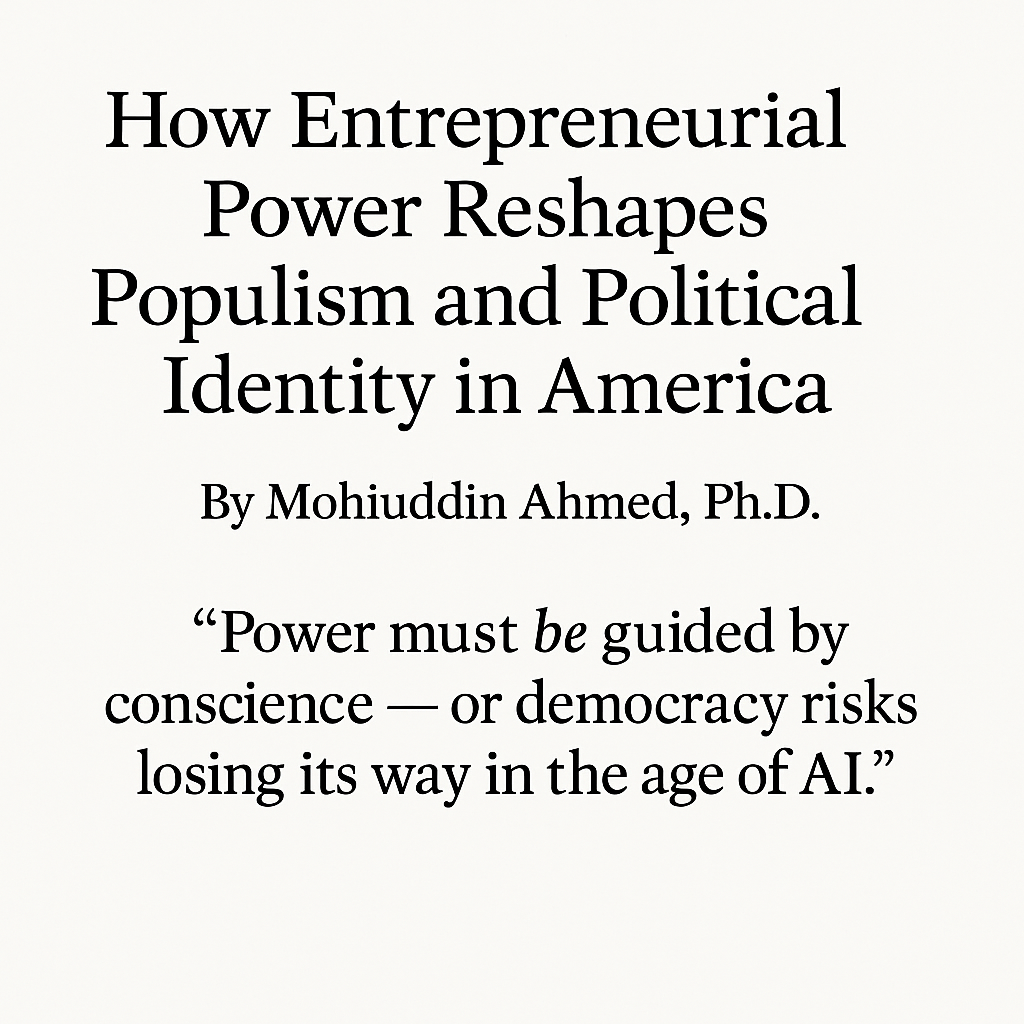
Contemporary Reflections: Entrepreneurs, Business Power, and Political Strategy

Introduction: When Business Meets Politics

A growing phenomenon in American life reveals that entrepreneurs are no longer content to remain behind the scenes. They are entering politics not merely as donors but as designers of policy—reshaping how the nation defines success, fairness, and identity.

This shift helps explain a critical question of our time: Why does MAGA-style populism retain such emotional and cultural appeal?

Beneath the slogans lies a strategic alliance: entrepreneurial elites seeking to shape the economic framework of the nation, and working-class citizens yearning for dignity, stability, and purpose. Together, they are redefining modern populism and the very meaning of political power.

Politics as an Extension of Business Strategy

Entrepreneurs understand that innovation alone cannot secure success. The ecosystem in which business operates—taxation, trade, labor laws, regulation, and cultural norms—is equally decisive.

Political participation has therefore become a logical extension of business strategy. By influencing policy, business leaders create not only favorable markets but also a cultural climate aligned with their values and vision of progress.

This is no longer traditional lobbying. It represents a systemic evolution—from competing within the market to shaping the rules that govern it.

A Convergence of Interests

The populist promise to “bring jobs back” resonated with two constituencies that once saw themselves as worlds apart.

For business elites, it suggested deregulation, lower taxes, and renewed domestic production.
For workers, it evoked dignity, pride, and the restoration of meaning to work and community.

This unlikely partnership has produced a new form of economic nationalism—pragmatic, emotionally charged, and fiercely identity-driven.

From Campaign Donors to Policy Architects

Today’s entrepreneurs—from Elon Musk and Larry Ellison to Peter Thiel and other influential digital and industrial innovators—no longer limit themselves to markets. They have become architects of public policy, shaping debates over energy, trade, technology, freedom, and the nation’s future direction.

Politics itself has become an advanced form of enterprise management, where success is measured not only in profit or votes but in the power to define values, narratives, and long-term purpose.

Global Reflection: Why Populism Feels Different Across Nations

In recent weeks, while watching documentaries on Siberia and Russia and reading History magazine on Libby, I developed a renewed appreciation for the cultural and psychological depth of reverence for centralized authority in Russian society.

This reverence persists even when authority becomes despotic. It reflects centuries of harsh geography, spiritual traditions, national mythology (“Mother Russia”), and collective memory that Western analysts often overlook.

This pattern extends across many regions: Afghanistan, the Middle East, parts of Africa, and numerous post-colonial societies. Populist causes there cannot be understood through Eurocentric ideals alone.

Here in the United States, democratic traditions run deep, and the political pendulum swings back and forth with relative stability. But in Russia, North Korea, Afghanistan, and similar nations, Eurocentric assumptions do not easily apply.

Many of us raised in Western-style educational traditions—often representing a small, elite minority shaped by colonial histories and blended identities—were taught to view liberal democracy as a universal model. Today, it is clearer than ever that it is not universally transferable.

The Moral Question: What Should Guide Power?

All of these dynamics bring us back to a timeless philosophical question: To what end is power exercised?

Throughout history, civilizations have been shaped by control over land, production, and trade. Today, the primary resource is policy itself—and those who shape it influence both material outcomes and the moral direction of society.

Transactional pursuits sustain life, but idealism sustains civilization.

Idealism—grounded in democratic principles, universal spiritual values, and expressed through diverse religious traditions—affirms equality, justice, the dignity of the individual, and our yearning for connection with a Universal Force that transcends personal circumstance.

A healthy society requires balance between pragmatic interest and ethical purpose, nationalism and global belonging, sovereignty and solidarity, material ambition and spiritual continuity.

Human history swings like a pendulum through these tensions. Leadership—corporate, political, intellectual, and technological—must ensure that power remains guided by principle and that prosperity serves human dignity.

AI and the New Struggle Over Truth

The convergence of entrepreneurial influence, populist identity, and modern media has now been magnified by a powerful new force: AI.

AI can illuminate truth—or blur it. Its ability to generate highly refined narratives, emotionally appealing arguments, and persuasive messages makes it a potential tool for deeper understanding—or sophisticated propaganda.

This reality demands a new level of reflective judgment from citizens, leaders, educators, and institutions. We must learn not only to evaluate content but to question how and why it was generated.

AI challenges us to engage our conscience more urgently than ever.

Conclusion: A Call for Ethical Leadership

We stand at a pivotal moment.

The fusion of entrepreneurial power, populist emotion, global identity struggles, modern media, and AI-driven narratives is reshaping democratic life.

If guided by vision and conscience, these forces can redirect innovation toward the common good. If driven by ambition and manipulation, they may deepen inequality, distort reality, and weaken democratic trust.

True progress requires the integration of intelligence with conscience—aligning creativity, technology, and ethical purpose.

In an age increasingly shaped by AI, this alignment is not optional. It may determine the fate of democracy itself.


Related Readings


Hashtags for Cross-Platform Sharing

.#Entrepreneurship
#Populism
#PoliticalStrategy
#AIandSociety
#EthicsInLeadership
#MoralLeadership
#AmericanIdentity
#ExistentialPerspectives
#Democracy
#MediaPsychology
#Advertising
#Globalism
#PoliticalIdentity
#UniversalHumanity
#PublicPolicy